Tuesday, September 20, 2011

view from my window: sunset

a 6.9 magnitude earthquake struck India and Nepal two days ago. i was sitting at my dining room table and felt the building swaying. people came out of their apartments and into the hallways, and some went downstairs. there was no damage here, but it is a strange feeling when everything is moving like that.

the rains have let up over the past few days. my windows face south and west, so there are good views of the sunset over chittagong.


Saturday, September 17, 2011

view from my window: monsoons

 it is almost the end of the rainy season, and lately its been rain, rain, rain. the average annual rainfall in chittagong is around 106 inches. as a point of comparison, seattle has an average of 53 inches.


working

as i mentioned in an earlier post, one of the most interesting things about living in bangladesh is watching people at work. many people make a living with their bodies, and those bodies (especially male ones) are at work in a very public way.


looking around, it is hard to resist the conclusion that there is a very uneven distribution in how hard people work. this is true most everywhere, of course, but especially striking here.

on the one hand, there are many people who seem to spend all day standing around doing nothing. a building will often have several doormen, when one seems sufficient. and small shops frequently have groups of apparently able-bodied men sitting around, just passing time.

for example: when keith was here, we visited a small shop, similar in size and offerings to a 7-eleven. we were the only two people in the store, and keith counted 14 employees. most of whom, of course, were standing around with nothing to do. and one finds this everywhere in bangladesh.

on the other hand, there are many people who frequently work for hours at backbreaking, exhausting tasks - pulling carts, or carrying bricks, or driving rickshaws or sorting through trash. and then, of course, there are the many factory workers, who work for long hours with little pay, and whose work is hidden from view.


i am not suggesting, of course, that those who are not working - or not doing very productive work - are lazy or at fault. i assume, rather, that there are larger economic and political structures - national and global - that explain both: 1) why many people here are unemployed, or employed in jobs that seem to accomplish very little, and 2) why so many people are forced to do crushing work, with no safety protections and little remuneration.

i also recognize that is easy to romanticize the physical labor of others, to gloss over what is boring and monotonous and painful in their labor. even so, i find something to admire and appreciate in the physical labor of many bangladeshis.  


Tuesday, September 13, 2011

new classes, new haircut

to celebrate the start of the term, i got a haircut and a shave a couple nights ago. the barber didn't speak a bit of english, and i certainly couldn't explain what i wanted in bangla. so i pointed at someone whose hair was roughly the same length i wanted, and i think i got the standard cut. 

the barber didn't have electric clippers, so everything was done with scissors and and razor. after the haircut, he gave me a shave with a straight razor. then he put on several other creams and lotions, and he gave me another shave. then he gave me a head massage and pounded on my shoulders. it was pretty relaxing.

the barber took his job very seriously, which i appreciated. neither of us felt a need to make smalltalk. in keeping with my interest in photographing people at work, i was able to slip out my phone and take a few pictures.


the front is a little longer than i would normally choose, but i'm embracing it. i think it has kind of a rockabilly look. here is the finished product:

in my office


Monday, September 12, 2011

first day of class: democracy hospital

today was the first day of class at AUW. i am teaching two courses this term - intro to political philosophy, and intro to ethics. both of my courses meet on mondays and wednesdays, so i have a great schedule. you can find the syllabi for my courses on the teaching section of my work site.

both of my classes went well today. the students were engaged and attentive. most of these students have never had a philosophy class, and so they are not quite sure what to expect. in light of this, i thought it was only reasonable to begin by working through Kant's division of the forms of rational cognition.


just kidding. i'm saving the Kant for later. actually, i began the the political philosophy class with Democracy Hospital: 

we tend to think that democracy is great, that everyone should get a share in political decision making. but imagine a hospital where medical decisions are made by polling people on the street, instead of by consulting the doctors (Pure Democracy Hospital). or where people on the street decide who the "doctors" are through a popularity contest, and then those "doctors" make the medical decisions. (Representative Democracy Hospital). now, who wants to get treated at Democracy Hospital? if you wouldn't want to go to Democracy Hospital for your physical health, why would you want to live in a democratic state, where much beyond your health is decided by letting everyone have a say in how things should be done, no matter how wise or foolish those people are? 

this worked well as a way to begin the class. it sets a good tone if you start by jumping in and doing philosophy, instead of beginning with the syllabus, course policies, etc.  and the students found the Democracy Hospital example engaging. most of them sensed that the example was missing something, but they weren't sure how to articulate why they disagreed with it.

most of the students were firmly committed to democracy as the best form of government, but not all. at least one spoke in favor of monarchy. she is one of my Nepali students.

i thought her sympathy toward monarchy was interesting, since it was only in 2006 that the king of Nepal agree to relinquish his power. and in the decades before that the monarchy was involved in numerous violent political struggles

nearby Bhutan has only recently transitioned from being an absolute monarchy to a constitutional monarchy. from what i understand, the king of Bhutan remains quite popular among his people. and he appears to be quite dashing as well.


Saturday, September 10, 2011

view from my window: rickshaws

rickshaws are everywhere in chittagong. they wait for potential passengers to hail them, as you would a taxi in an american city. the ride from my apartment to the university - perhaps 1.5 miles - costs around 20 or 30 taka (1 dollar = 75 taka).

because rickshaws don't have gears, wallahs frequently have to get out and pull a rickshaw with passengers up a hill, as is seen below. it is common for several people to ride together, and i have seen as many as six people in a single rickshaw - two women and four children. 

the typical rickshaw wallah wears a skirt-like piece of fabric tied around his waist, and a pair of cheap plastic sandals. as you might guess, rickshaw wallahs are very lean and muscular. 


rickshaw wallahs work in sunshine and in rain. when it rains, a wallah will pull a plastic tarp across a line to keep his passengers dry, and occasionally use an umbrella for himself.

although most are young, it is not uncommon to see a wallah who is well into middle-age, with gray in his beard.


Thursday, September 8, 2011

advising and registration

today was filled with advising appointments. i have 13 advisees - 1 from burma, and 12 from nepal. out of that group, 4 or 5 have the last name "shrestha," so i gather this must be like "jones" + "smith" in nepal. in a google search for "shrestha," the second result is this article about a train robbery. teaser quote: "fighting the enemy in battle is my duty as a soldier. taking on the thugs on the train was my duty as a human being." (warning: this article may not be suitable for young or more sensitive readers.)

all of my advisees are first year undergraduates. i met with each of them to talk about the courses being offered, and the core requirements, and potential majors. then we settled on a list of classes for each of them to take.

tomorrow and the next day are registration. the plan had been to have a new computerized system in place. but that fell through, because of recent administrative turmoil, including the resignation of our registrar. so we are doing things the old fashioned way, with tables and sign-up sheets in an auditorium.

i am teaching two courses this term: intro to political philosophy, and intro to ethics. i've never taught either before, though i have taught several of the texts we'll be reading -e.g. plato's republic, kant's groundwork.

i'm really looking forward to the start of classes. the students are such an eager, inquisitive bunch. almost all of them have made a huge investment to get here (around 75% are from outside of bangladesh), and many of them are very bright. plus there is that campus-in-the-fall energy that comes with the start of the new school year. a distinct pleasure of the academic life. (even in chittagong.)


to all of you who have been reading and commenting on these dispatches, i express my gratitude:


Wednesday, September 7, 2011

ramu

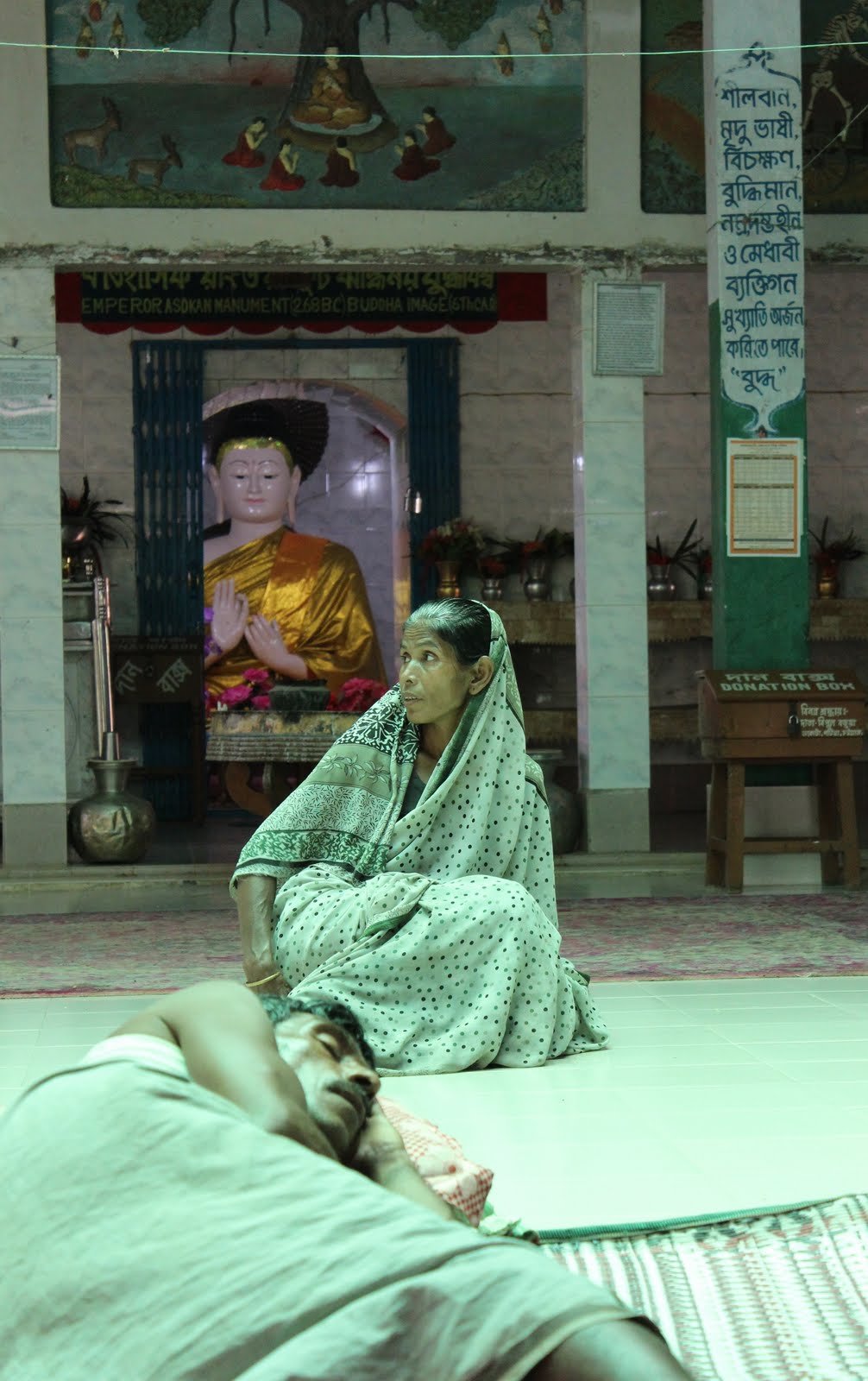
while staying in cox's bazar, we took a day trip to ramu, which is a small town nearby. there is buddhist temple there, that sits at the top of a small hill. at the bottom is an enormous, beautiful tree. 


the head monk showed us around and explained their relics to us - including (supposedly) a piece of the buddha's breastbone, kept inside one of the statues. there are several monks (or perhaps monks-in-training, i'm not sure) who live at the monastery. there are also people who come there to worship and pray, or to sit and sleeping. i can see why people would spend an afternoon resting there - it was a quiet, peaceful space, in a country that is often crowded and noisy. the light inside the temple came through skylights that had a green tint, so everything inside was bathed in a greenish light.


they gave us water and apples, and we sat with them for while. if i understood him correctly, the monk said that the temple site dates back to several hundred years B.C. it was destroyed, however, during the mughal period. it was then rebuilt in the early 20th century. they are now trying to secure funds for more archaeological investigation at the site, and to develop a small museum.


jolie (a prof at AUW) is on the right


Sunday, September 4, 2011

on the water

some fishermen in the waters off cox's bazaar


this man was cooking some dinner on his boat. he allowed me climb up, walk around, and takes some pictures. and he offered me some of what he was cooking - onions and fish 


one of the features of bangladesh is that many people work with their bodies, and many of these people work in a highly visible, public way. i find this to be one of the most engaging aspects of life here. it provides a constant source of interesting scenes to observe - people (mostly men) using their hands, arms, and legs to move and to mold the dirt or rope or wood or metal.


Friday, September 2, 2011

beaches and mangroves

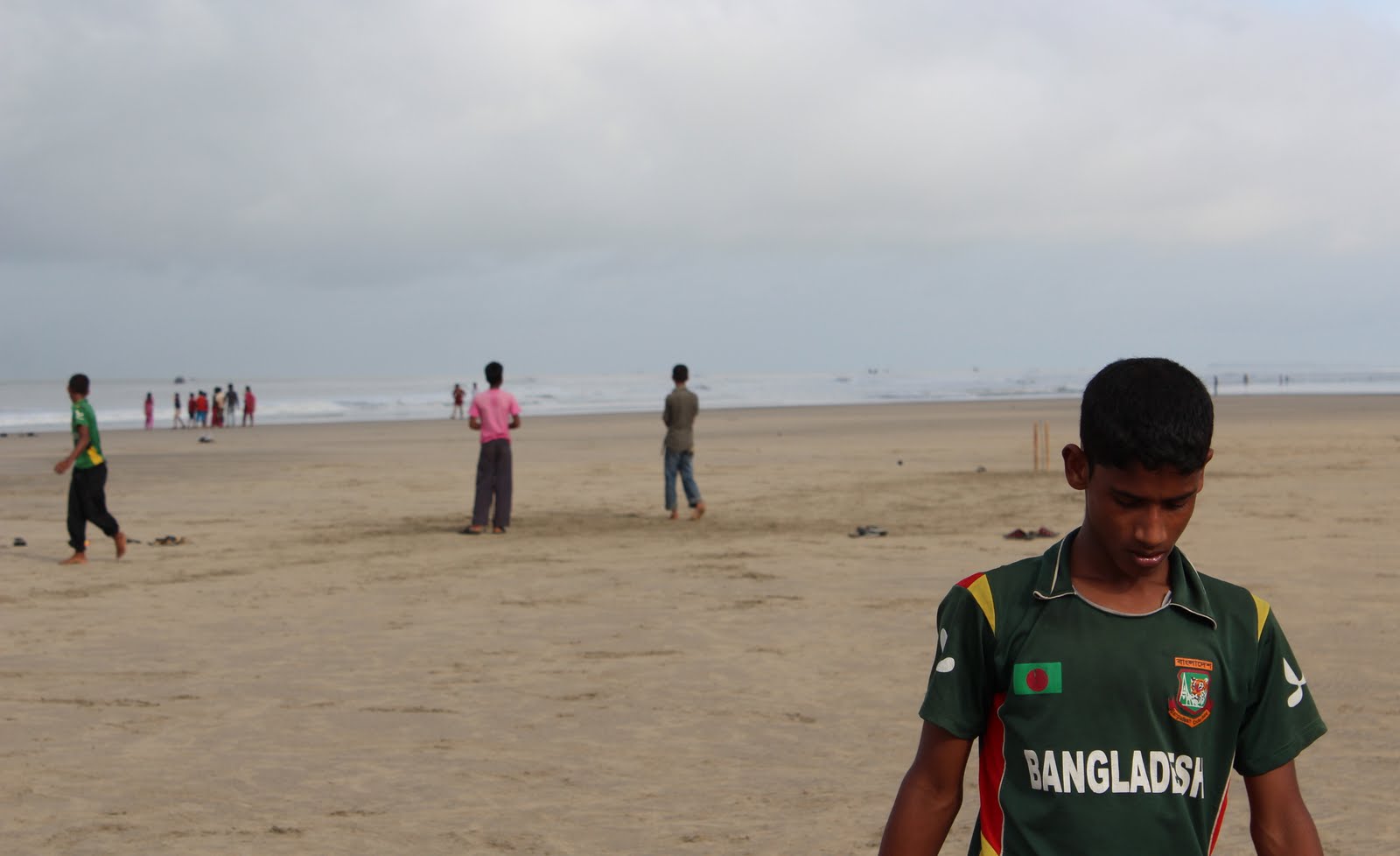
here are some more photos from our trip to cox's bazar. by sunrise each morning, there were groups of boys playing cricket by the ocean.


the children were very friendly. in bangladesh, whites are still rare enough that most children are fascinated by seeing a white person. and most adults stare at you. here are some kids we met on a walk along the beach.


during one of the days in cox's bazar, we took a boat over to a small island just off the coast, called maheshkhali. we rode around in rickshaws, ate fish in a local restaurant, and visited some hindu and buddhist temples.

we also ran into some local kids jumping off a bridge into a mangrove swamp. they welcomed us to join in their fun.


later the kids from the swimming joined us for a walk in hills. there was a group of boys that reminded me of the three brothers in "the tree of life" - the way they would run together like a pack, and hang on one another without being self-conscious, and take delight in the trees and water and sky and their arms and legs and each other